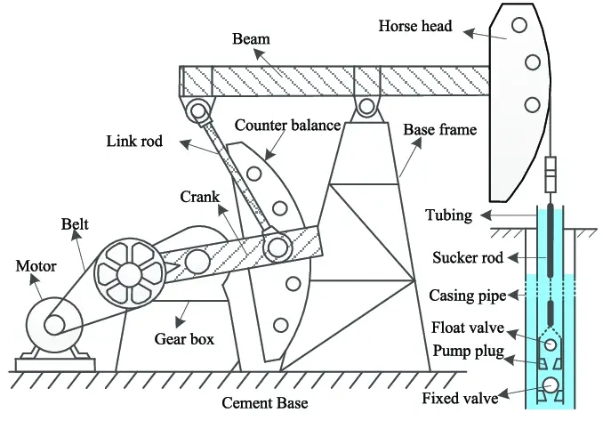
Sucker Rod Pump (SRP): 1) Surface components:
2) Subsurface components
How is the liquid lifted to the surface?
Advantages and Disadvantages:
Disadvantages:
Sucker Rod Pump (SRP), also known as a rod pump or beam pump, is a type of artificial lift system commonly used in the oil and gas industry to lift fluids, such as crude oil or water, from a well to the surface
Component of Sucker Rod Pump (SRP) .
1-Prime Mover:
Provides the power to operate the pumping unit
2-Pumping unit:
It converts the rotary motion of the prime mover into the reciprocating motion required to operate the downhole pump.
It consists of walking beam - horsehead - crank - counterbalance.
3-Polished rod:
It is a long, smooth rod that connects the pumping unit to the downhole pump.
1-Sucker rod string:
These rods transmit the reciprocating motion from the polished rod to the downhole pump.
2-Downhole pump:
It is responsible for lifting fluids to the surface.
It consists of Hold down assembly – barrel - Standing valve - Traveling valve - Plunger
3-Tubing anchor:
It secures the tubing in place within the wellbore and preventing it from moving or vibrating during operation.
During the upstroke cycle the pump plunger is lifted upwards by the sucker rods connected to a pumping unit on the surface. As the plunger moves upwards, it creates a low-pressure zone below it, causing the liquid in the wellbore to be drawn into the pump barrel through the standing valve at the bottom of the pump. The standing valve opens to allow the liquid to enter the pump barrel, and then closes to prevent the liquid from flowing back into the wellbore during the downstroke cycle.
During the downstroke cycle the plunger is pushed downwards by the sucker rods, forcing the liquid in the pump barrel to be pushed upwards towards the surface. The traveling valve at the top of the pump opens to allow the liquid to flow out of the pump barrel and into the production tubing, and then closes to prevent the liquid from flowing back into the pump barrel during the upstroke cycle.
Advantages:
• Cost-Effective: Sucker Rod Pumps are generally cost-effective compared to other artificial lift systems.
• Versatile: They can be used in a wide range of well conditions and are adaptable to various production scenarios.
• Simple Design: Sucker Rod Pumps have a relatively simple design, making them easy to operate and maintain.
• Limited Depth: Sucker Rod Pumps struggle in deep wells; ESP or Gas Lift are better.
• Mechanical Wear: Pump plunger motion causes wear, especially in abrasive fluids.
• Corrosion: Susceptible to corrosion in corrosive fluids; needs corrosion-resistant materials.
• Limited Gas Handling: Inefficient in high gas wells, leading to gas locking; Gas Lift may be better.