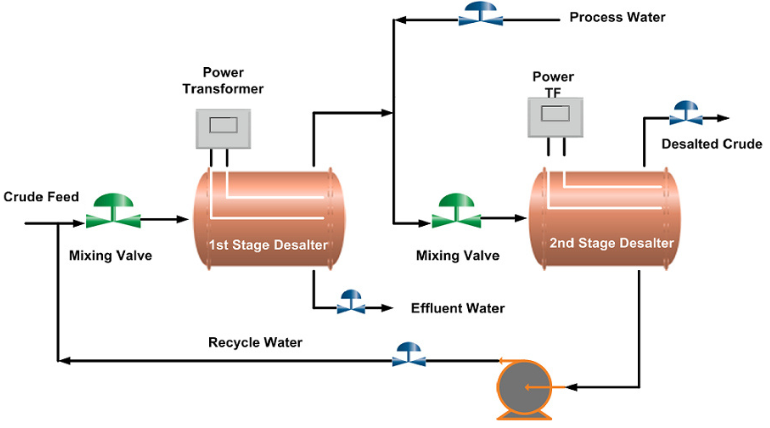
Desalter Unit
Desalter is processing equipment in the refinery that removes salt and other impurities from crude oil. Desalter in a refinery is one of the major components. It is typically the first unit towards cleaning and processing crude oil and its distillation. 🔵Purpose The primary goal of a desalter is to: 1.Remove Salts: Salts (mainly sodium chloride, calcium chloride, and magnesium chloride) are dissolved in the water present in crude oil. If not removed, these salts can cause corrosion, fouling, and catalyst deactivation in downstream processing units. 2.Remove Water: Crude oil often contains water in the form of emulsions, which needs to be removed to prevent issues in downstream units. 3.Remove Sediment: Solid particles or sediments also need to be removed to avoid equipment wear and blockages. 🔵 Operating Parameters 1.Temperature: Higher temperatures reduce the viscosity of crude oil, improving the separation of water and oil. 2.Pressure: Typically operated at moderate pressures to maintain the crude oil in liquid form. 3.pH Control: Maintaining the pH of the wash water to prevent corrosion. 4.Demulsifier Chemicals: Added to aid in breaking the water-in-oil emulsion. 🔵This Desalting process is done in two steps: ◾1st Step is to dilute the dispersed water-soluble salt content with fresh water ◾ 2nd Step is to remove diluted dispersed brine from crude oil.🔵Types of Desalters
1. Single-Stage Desalter: Suitable for crude oils with low salt content.
2. Two-Stage Desalter: Used for crude oils with higher salt content, providing more effective desalting by using two sequential desalting stages.
🔵Working Principle
The desalter unit works on the principle of electrostatic separation combined with chemical demulsification. Here's a step-by-step explanation:
1.Mixing with Water: Crude oil is mixed with fresh water, typically at a ratio of 3-10% by volume. The water dissolves the salts present in the crude oil.
2.Chemical Injection: Demulsifying agents (chemicals) are added to break the oil-water emulsion and enhance the separation of water from oil.
3.Heating: The crude oil-water mixture is heated to reduce viscosity and enhance the separation process.
4.Electrostatic Separation: The mixture enters an electrostatic coalescer, where an electric field is applied. This causes water droplets to coalesce into larger droplets, which then settle due to gravity.
5.Separation and Removal: The water, now containing dissolved salts and other impurities, settles at the bottom and is drained off. The desalted crude oil, with reduced salt content, moves to the next stage of refining. ”